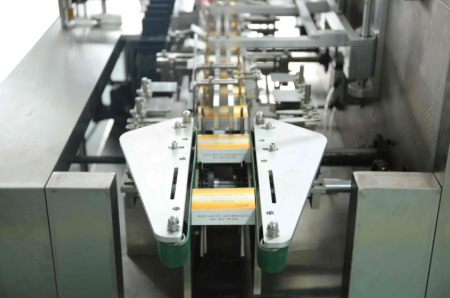
Investing in a cartoning machine is a significant decision — and choosing the wrong one can cost your business far more than just money. The right machine will streamline your production, reduce costs, and scale with your growth. The wrong one will create bottlenecks, require constant adjustments, and fail to meet industry-specific requirements.
With so many models, configurations, and suppliers available, how do you make the right choice? This guide walks you through the key factors every business must consider before purchasing a cartoning machine.
1. Understand Your Product Type First
The single most important factor in choosing a cartoning machine is the nature of your product. Different products require completely different machine configurations.
- Solid and rigid products such as bottles, tubes, blister packs, and vials are best suited for horizontal cartoning machines, where items are inserted from the side with precision.
- Loose, granular, or irregular products such as tea bags, powders, cereals, or sachets work better with vertical cartoning machines, where products drop in from the top.
- Fragile products require machines with gentle handling mechanisms and adjustable speed controls to prevent damage during insertion.
Always start with your product’s shape, size, weight, and fragility before evaluating any machine.
See also: The Relationship Between Technology and Productivity
2. Know Your Required Production Speed
Production speed is measured in cartons per minute (CPM). Before speaking with any supplier, calculate how many cartons your business needs to produce per hour, per shift, and per day at peak demand.
Entry-level cartoning machines typically handle 50 to 150 CPM, while high-speed industrial cartoners can exceed 500 CPM. Choosing a machine that operates at your maximum required speed with some headroom for growth ensures you won’t face a capacity bottleneck within a few years of purchase.
Avoid the mistake of buying purely based on current output needs. Factor in your projected growth over the next five years.
3. Consider Your Industry’s Specific Requirements
Different industries come with different regulatory, hygiene, and operational demands. Your cartoning machine must be built to meet them.
- Pharmaceutical industry: Requires machines with tamper-evident sealing, serialization compatibility, leaflet insertion systems, and integration with track-and-trace software for full regulatory compliance.
- Food and beverage industry: Demands food-grade stainless steel construction, easy washdown capability, and compatibility with hygiene standards such as IP65 ratings to prevent contamination.
- Cosmetics industry: Prioritizes gentle product handling, high aesthetic finish on cartons, and flexibility to accommodate varied bottle and tube shapes across product lines.
- E-commerce and consumer goods: Needs machines that handle diverse SKUs efficiently with fast changeover capability and consistent seal quality for shipping durability.
Matching the machine to your industry’s standards from the start saves costly modifications later.
4. Evaluate Carton Type and Sealing Method
Cartoning machines seal cartons in two primary ways — tuck-in end closure and hot glue sealing. Each has its place depending on your product and market.
Tuck-in closures are cost-effective, require no adhesive, and allow easy opening by consumers — ideal for retail products. Hot glue sealing provides a stronger, tamper-evident closure preferred in pharmaceuticals and products that must survive rough shipping conditions. Some machines offer both options, giving you greater flexibility.
Ensure the machine you choose is compatible with your chosen carton board weight and your preferred sealing method.
5. Assess Changeover Flexibility
If your business produces multiple products or carton sizes, changeover time between formats is critical. Some machines require extensive manual adjustments when switching between product formats, costing hours of downtime per changeover.
Look for machines with tool-free changeover systems, pre-programmable format settings stored in the HMI, and modular components that can be swapped quickly. A machine that changes formats in under 30 minutes gives your operation the agility to respond to market demands without sacrificing efficiency.
6. Check Integration Capability
A cartoning machine rarely works in isolation. It must integrate smoothly with your existing production line — upstream filling equipment, labeling systems, vision inspection cameras, and downstream case packers or palletizers.
Before purchasing, confirm that the machine’s electrical specifications, conveyor heights, and communication protocols are compatible with your current equipment. Machines equipped with standard PLC systems and open communication interfaces are far easier to integrate than proprietary systems.
7. After-Sales Support and Spare Parts Availability
Even the best machine will eventually need maintenance, repairs, or replacement parts. Choosing a supplier with a strong local or regional service network, readily available spare parts, and responsive technical support is just as important as the machine’s specifications.
Ask potential suppliers about their average response time for service calls, availability of operator training programs, and warranty terms before making your final decision.
Conclusion
Choosing the right cartoning machine comes down to deeply understanding your product, your industry’s requirements, your production goals, and your future growth plans. A machine that ticks all these boxes will deliver years of reliable, profitable performance.
Take the time to evaluate your options carefully, request live demonstrations where possible, and work with suppliers who understand your specific industry. The right cartoning machine is not just equipment — it is a long-term partner in your production success.